
Recognizing Connections: Community Partners Who Strengthen Saskatchewan’s Research Community
The Recognizing SHRF Connections initiative spotlights individuals who have contributed to Saskatchewan's vibrant health research community by volunteering their time and sharing their experience and expertise, even though research is not part of their official role.
Through the Recognizing Connections initiative, SHRF acknowledges that community leaders, advocates, people with lived experience, frontline workers, and other key contributors are essential in enriching the research process with crucial insights, support, and real-world perspectives, leading to more relevant and impactful outcomes.
These nominees were recognized and celebrated at the Annual Santé Awards on January 29th, 2026. Their contributions help bridge research and practice, resulting in work that is more relevant, responsive, and connected to people and communities.
Melissa Schmidt
Venvi The Bentley Regina, Cogir Senior Living

Melissa Schmidt was instrumental in the success of the SHRF-funded “Artful Encounters: Re-Imagining Older Adult Health and Well-Being” project, which involved older adults participating in artistic opportunities, either by creating art or by experiencing it as an audience member. Ultimately, it was the residents’ trust in Melissa, Active Living Aide at The Bentley in Regina, that supported them to participate.
The team knew that if older adults participated, they would enjoy the experience and find meaning from the storytelling, painting, poetry, and other activities. The project found that all participants were pleased with the experience; some said they might not have attended without Melissa’s encouragement. Many also said that Melissa does an excellent job planning their usual activities; it was her endorsement and hosting of the program that convinced them to join.
In many ways, Melissa goes above and beyond what is expected of her in her job, but that did not prevent her from helping support the research team in so many ways including help in changes to scheduling, marketing the encounters, assisting in getting consent and exit forms filled out, and even participating in the activities, which made participants (and research collaborators) feel at ease.
She also offered many suggestions to improve Artful Encounters, including increasing attendance, designing better ways to encourage participants to complete forms, and strengthening relationships with artists and participants to foster greater reciprocity.
She truly was the bridge among the older adult participants, the university researchers, and the community artists.
Without Melissa, the team would have lacked crucial insights, invaluable expertise, and her passion for helping others.
Martha Morin, Mandy Herman, Christie Janvier, Chelsey Stonestand, Eleanor Stonestand and Rhonda Sanderson
On behalf of the James Smith Cree Nation and La Loche Communities

The community researchers supporting the “Pathways to safer communities: Co-creating a crisis preparedness framework for Indigenous communities” project have made outstanding contributions to advancing health research in Saskatchewan by sharing their lived experience, cultural knowledge, and leadership in crisis response.
Their involvement has been essential in ensuring this SHRF-funded project remains rooted in the realities, strengths, and priorities of the communities it serves.
Representatives from the James Smith Cree Nation and La Loche stepped forward not as researchers by profession, but as community leaders, family navigators, and knowledge holders directly affected by mass-casualty crises.
Their insights provided invaluable guidance in co-developing a community crisis preparedness framework. This framework is designed to help leaders navigate overwhelming and traumatic circumstances by outlining priorities, resources, and culturally responsive practices when entire communities are affected by crisis.
The nominees contributed far beyond consultation. They served as sub-investigators and research associates, guiding the ethics application, recruitment strategy, data collection, and analysis.
By conducting interviews, leading community engagement, and shaping the framework design, they ensured that this work reflects not only academic standards but also Indigenous traditions, values, and trauma-informed approaches. Their ability to foster trust and kinship between James Smith and La Loche has created strong inter-community connections that will support long-term healing and resilience.
Importantly, their contributions extend to capacity-building. By mentoring student researcher assistants, collaborating with faculty, and modelling community-based participatory action research, they have created pathways for future Indigenous researchers and ensured that knowledge mobilization outputs remain accessible and meaningful to those who need them most.
Through generosity, courage, and commitment, these community researchers have transformed a research project into a living, community-owned resource.
The Saskatchewan Pain Society Inc. (SaskPain)

SaskPain is a non-profit organization, governed by a volunteer board that includes people with lived experience of pain, healthcare providers, researchers, and community members, to improve understanding of pain and advance practice to better support people living with pain across the province.
SaskPain supports community-based research for people living with pain in Saskatchewan. Through participant recruitment, fostering research partnerships, and knowledge mobilization, SaskPain helps ensure that studies are relevant, accessible, and directly tied to the needs of those living with chronic pain.
An example of this support is with the SHRF and SCPOR-funded “Improving Pain Care Through Emerging Saskatchewan Health Networks” project. SaskPain facilitated contact between researchers and people living with pain for participant recruitment.
Online resources ensure people living with pain, families, and healthcare providers can learn about the projects and share in the findings, even long after the study closure.
For example, a children's book on chronic pain and a curriculum guide for teachers of Grade 3-4 students were produced. These books and the curriculum guide remain available for free download from the SaskPain website.
In collaboration with researchers, SaskPain hosted an online support group for adults living with pain and a podcast called “Your Partners in Pain”. SaskPain creates spaces where researchers and those living with pain can meet and build relationships. SaskPain helps ensure that research is grounded in lived experience, meaning that participant voices shape what research gets done, what questions are asked, and how outcomes are shared.
Their efforts help bridge the gap between research and practice by making findings understandable and relevant, and by promoting uptake of best practices in pain management.
SaskAgMatters Mental Health Network Inc.

The SaskAgMatters Mental Health Network was created directly from the Saskatchewan Farmer and Rancher Mental Health (FARMh) Initiative, a community-engaged research program supported by SHRF and SCPOR that sought to understand and improve mental health supports for agricultural producers.
Through FARMh, researchers spent extensive time listening to farmers' lived experiences, mapping stressors unique to rural life, and co-designing solutions that reflected the realities of life on farms and ranches.
It became clear that the research could not remain confined to academic outputs; it needed to live on through a farmer-led network that would sustain momentum, connect stakeholders, and drive ongoing knowledge mobilization. From those early conversations, farmers themselves helped co-create what would become SaskAgMatters.
Producers who participated in FARMh envisioned a structure that could both inform and be informed by research. They shaped the guiding principles of SaskAgMatters: collaboration, inclusion, and farmer-driven priorities.
SaskAgMatters currently offers free mental health therapy to Saskatchewan producers, funded entirely by private donations and fundraising.
Today, SaskAgMatters stands as a unique embodiment of integrated knowledge translation. It is both a product and a partner of research, bridging science, lived experience, and practice.
SaskAgMatters continues to work alongside academic teams to identify emerging issues, co-develop studies, and ensure that findings are shared with communities in meaningful ways.
They help refine research questions, recruit participants, interpret data through a farm lens, and mobilize knowledge through media, guest speaking, publications, and outreach at agricultural events like Agribition.
Their evolution demonstrates how community partnership can turn research into real-world change, not just informing policy and programs, but nurturing a movement where farmers and researchers work hand in hand to advance mental health across Saskatchewan’s agricultural landscape.
Lung Saskatchewan
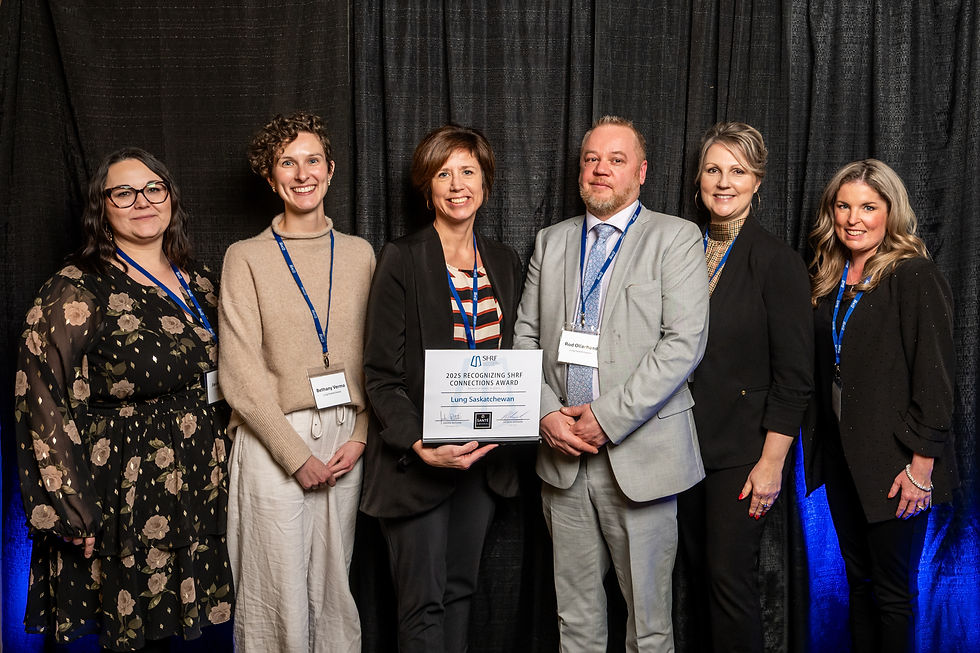
Lung Saskatchewan is a leader in evidence-informed initiatives. This past year, they partnered with the University of Saskatchewan Public Health Master's program, with support from SHRF funding, to develop the “My Radon Risk” initiative to help individuals, families, and communities act against radon exposure. Radon is the second leading cause of lung cancer and a major, yet preventable, public health concern.
The My Radon Risk initiative, developed by Lung Saskatchewan, is a provincial campaign that empowers individuals, families, and communities to act against radon exposure.
Through an interactive website, www.myradonrisk.ca, Lung Saskatchewan provides accessible, evidence-based resources that help people understand what radon is, why it matters, and how they can protect themselves. The site features an easy-to-use risk assessment tool, step-by-step guidance on home testing and mitigation, and direct links to certified radon professionals. By making complex science clear and actionable, the project equips Saskatchewan residents to make informed decisions about their health and homes.
Lung Saskatchewan plays a central role in this project by leading public education, coordinating community outreach, and ensuring that materials are culturally safe and relevant.
The organization leverages its trusted reputation and broad provincial networks—including healthcare providers, schools, municipalities, and community-based groups—to ensure evidence reaches those most at risk.
Beyond awareness, Lung Saskatchewan advocates policy change, including enhanced support for radon testing and mitigation, so that families are not left to shoulder the burden of prevention alone.
Through public education, community outreach, and policy advocacy, Lung Saskatchewan demonstrates its commitment to research and lung health, reducing the burden of lung cancer in Saskatchewan and ensuring that residents have the knowledge, tools, and support they need to breathe safely in their homes.
About SHRF - Saskatchewan Health Research Foundation (SHRF) is the provincial funding agency that funds, supports and promotes the impact of health research that matters to Saskatchewan. SHRF collaborates with stakeholders to contribute to the growth of a high-performing health system, a culture of innovation, and improved health for citizens by strengthening research capacity and competitiveness, increasing investment in health research in Saskatchewan, and aligning research with stakeholder needs.
For more information, please contact:
Chelsea Cunningham, SHRF Programs and Engagement Manager


Comments